OLED vs Mini-LED: Understanding the Differences
Discover the core differences between OLED and Mini-LED displays in 2026, from perfect black levels and contrast to peak brightness and long-term reliability.
1. Understanding the Core Difference: Self-Emissive vs. Backlit
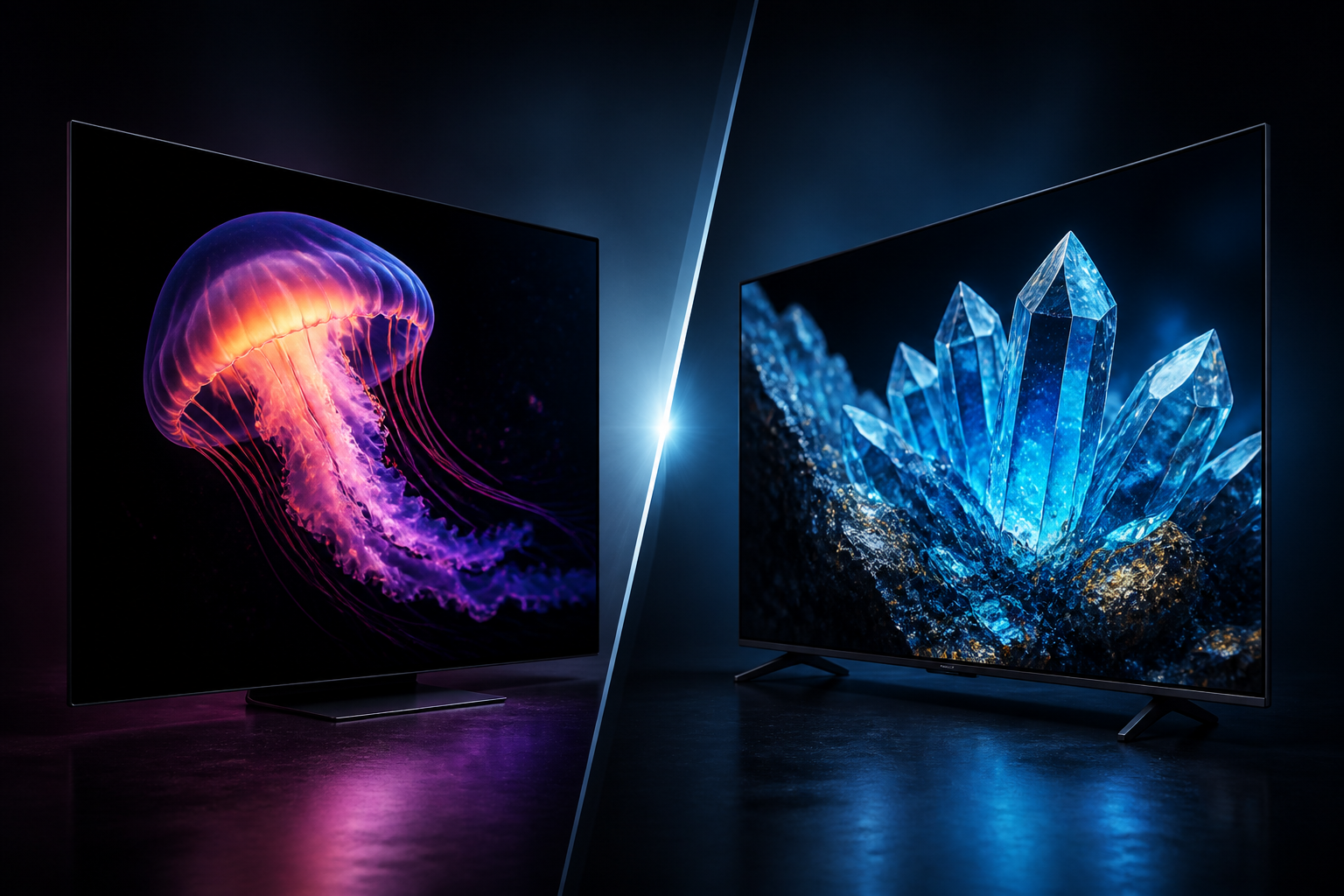
To understand the debate between OLED and Mini-LED, we first need to look at how a screen creates light. Every display requires a light source to make the image visible. The fundamental difference between these two technologies is where that light comes from.
OLED stands for Organic Light Emitting Diode. The "organic" part refers to the carbon-based film that sits inside the panel. OLED is a "self-emissive" technology. This means that every single pixel is its own light source. When the screen needs to show red, the red sub-pixels glow. When it needs to show black, the pixels simply turn off completely.
Mini-LED is actually an evolution of traditional LCD (Liquid Crystal Display) technology. In a standard LCD, a large panel of lights (the backlight) sits behind a layer of liquid crystals that act like shutters to let light through or block it. Mini-LED replaces those large lights with thousands of microscopic LEDs. Because these LEDs are so small, they can be packed much more tightly together, allowing for more precise control over which parts of the screen are bright and which are dark.
2. The Battle of Contrast and Black Levels
Contrast is the difference between the brightest white and the darkest black a screen can produce. It is widely considered the most important factor in perceived picture quality.
Because an OLED pixel can turn off entirely, it produces what we call "perfect blacks." There is zero light leakage. If you are watching a movie scene of a spaceship in deep space, the blackness of the vacuum is truly black. This creates a punchy, three-dimensional look because colors pop against that absolute darkness. There is no "haloing" or "blooming" around bright objects.
Mini-LED attempts to mimic this effect using Local Dimming Zones. By grouping the thousands of tiny LEDs into hundreds or even thousands of zones, the TV can turn off the backlight in dark areas while keeping it on in bright areas. While 2026 models have become incredibly sophisticated, they still occasionally struggle with "blooming." This happens when light from a bright object (like a white subtitle or a cursor) bleeds into the surrounding dark zone, creating a subtle foggy glow.
3. Brightness and HDR Performance
While OLED wins on darkness, Mini-LED usually takes the crown for sheer brightness. This measurement is typically referred to in "nits," a unit of visible-light intensity.
High Dynamic Range (HDR) content relies on "specular highlights"—think of the sun reflecting off a car's chrome bumper or the flash of an explosion. To make these look realistic, the screen needs to get very bright for a split second. Furthermore, if you are using your screen in a room with many windows and direct sunlight, a dimmer screen will look washed out or like a mirror.
- Mini-LED: Can often reach 2,000 to 4,000 nits. This makes them the kings of "bright-room" performance. They can fight through glare easily and make HDR highlights look incredibly intense.
- OLED: Generally tops out between 1,000 and 1,500 nits (though high-end 2026 panels are closing the gap). While plenty bright for most dark-room viewing, they can struggle in a sun-drenched sunroom during the day.
4. The Longevity Question: Burn-in vs. Reliability
When investing in a premium display, you likely want it to last for several years. This is where the chemical nature of OLED becomes a talking point.
Because OLED uses organic compounds, those compounds degrade over time as they are used. "Burn-in" occurs when a static image—like a news ticker, a video game HUD, or a Windows taskbar—is left on the screen for thousands of hours at high brightness. This causes those specific pixels to wear out faster than others, leaving a faint "ghost" of the image behind. Modern OLEDs use sophisticated pixel shifting and logo detection software to prevent this, making it a non-issue for most casual viewers, but it remains a theoretical risk for power users.
Mini-LEDs use inorganic materials that do not suffer from burn-in in the same way. You can leave a static spreadsheet or a 24-hour news cycle on a Mini-LED screen for years without worrying about permanent image retention. For this reason, many professionals prefer Mini-LED for computer monitors where static elements are the norm.
5. Viewing Angles and Color Consistency
How the image looks when you aren't sitting directly in front of the screen is another major point of differentiation. OLED is legendary for its viewing angles. Because the light is produced right at the surface of the pixel, you can sit far to the side of the couch and still see the exact same colors and contrast as the person sitting in the "sweet spot."
Mini-LED, being an LCD-based technology, often suffers from "gamma shift" or color washing when viewed from an angle. If you have a large sectional sofa and frequently host movie nights with a big group, the people on the ends of the couch might see a slightly degraded image compared to the person in the middle.
6. Color Volume and Saturation
Both technologies are excellent at reproducing colors in 2026, often covering nearly 100% of the DCI-P3 color gamut. However, OLEDs often feel more "saturated" because of the way those colors sit against a perfect black background. Mini-LEDs, conversely, can produce superior "color volume"—meaning they can maintain rich, vibrant colors even at extremely high brightness levels where OLEDs might have to desaturate to protect the panel from heat and wear.
Beyond the screen, hardware connectivity remains vital for 2026 setups. To ensure your display receives the highest quality signal, understanding modern cable standards is essential; our USB-C Explained guide provides a detailed look at how these connections handle high-resolution data.
Conclusion
In 2026, the 6 factors listed above demonstrate why both OLED and Mini-LED have reached a level of maturity where there is no wrong choice, only a "better for you" choice. The decision comes down to your environment and how you use your tech.
Choose OLED if you primarily watch movies in dimly lit rooms, value perfect black levels, and have a wide seating arrangement. Choose Mini-LED if your room has many windows, you use the screen for productivity with static windows, or you want the most "searing" HDR highlights available today.